Immersive Visual & Sensorimotor Stimulation
Designed for Optometrists and Vision Therapists
MoveR offers immersive, practitioner-guided visual and sensorimotor stimulation experiences for individuals aged 5 and up, without the need for a virtual reality headset.
Through interactive, movement-based activities, MoveR combines binocular and multimodal stimulation with dynamic motion and depth cues, engaging both central and peripheral vision.
Its highly customizable environments allow practitioners to adjust visual, spatial, and movement parameters in real time, bringing immersive stimulation experiences into their practice.
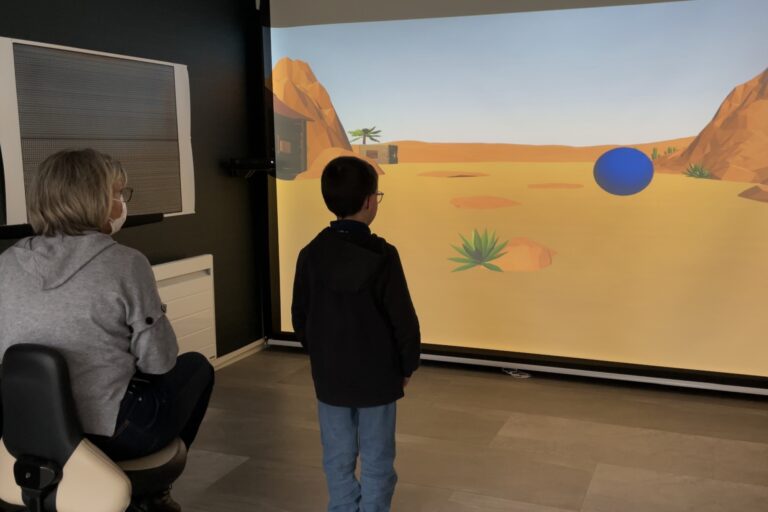
MoveR Premium combines large-scale immersion, active stereoscopy, and advanced customization to deliver rich, interactive stimulation experiences for optometrists, vision therapists, and other qualified professionals.
Designed for individuals aged 5 and up, the system offers immersive stimulation without a VR headset.
Key Features
-
Large-scale immersion: Extended display (8+ ft / 2.5+ m) with active stereoscopy
-
Rich multimodal stimulation: Dynamic visual environments combining motion, depth, contrast, and spatial challenges
-
Central and peripheral vision: Interactive activities engaging both central and peripheral visual fields
-
Visual-motion stimulation: Dynamic motion and optic-flow experiences
-
Visual–vestibular interaction: Movement-based activities combining visual and spatial stimulation
-
Eye-tracker compatibility
-
Complete experience library: Full access to the MoveR catalog
-
Advanced customization: Precise, real-time control over stimulation parameters
-
Premium technical support
-
Dedicated, fixed installation
Stimulation Focus Areas
MoveR Premium offers customizable activities involving:
-
Binocular stimulation and stereoscopic depth cues
-
Visual fixation, exploration, and spatial orientation
-
Central and peripheral visual stimulation
-
Visual motion, optic flow, and motion sensitivity
-
Visual attention, selective focus, and inhibition challenges
-
Contrast, grayscale, and fine-detail visual stimuli
-
Visual-motor coordination and lateralization
-
Visual–vestibular and balance-related sensory challenges
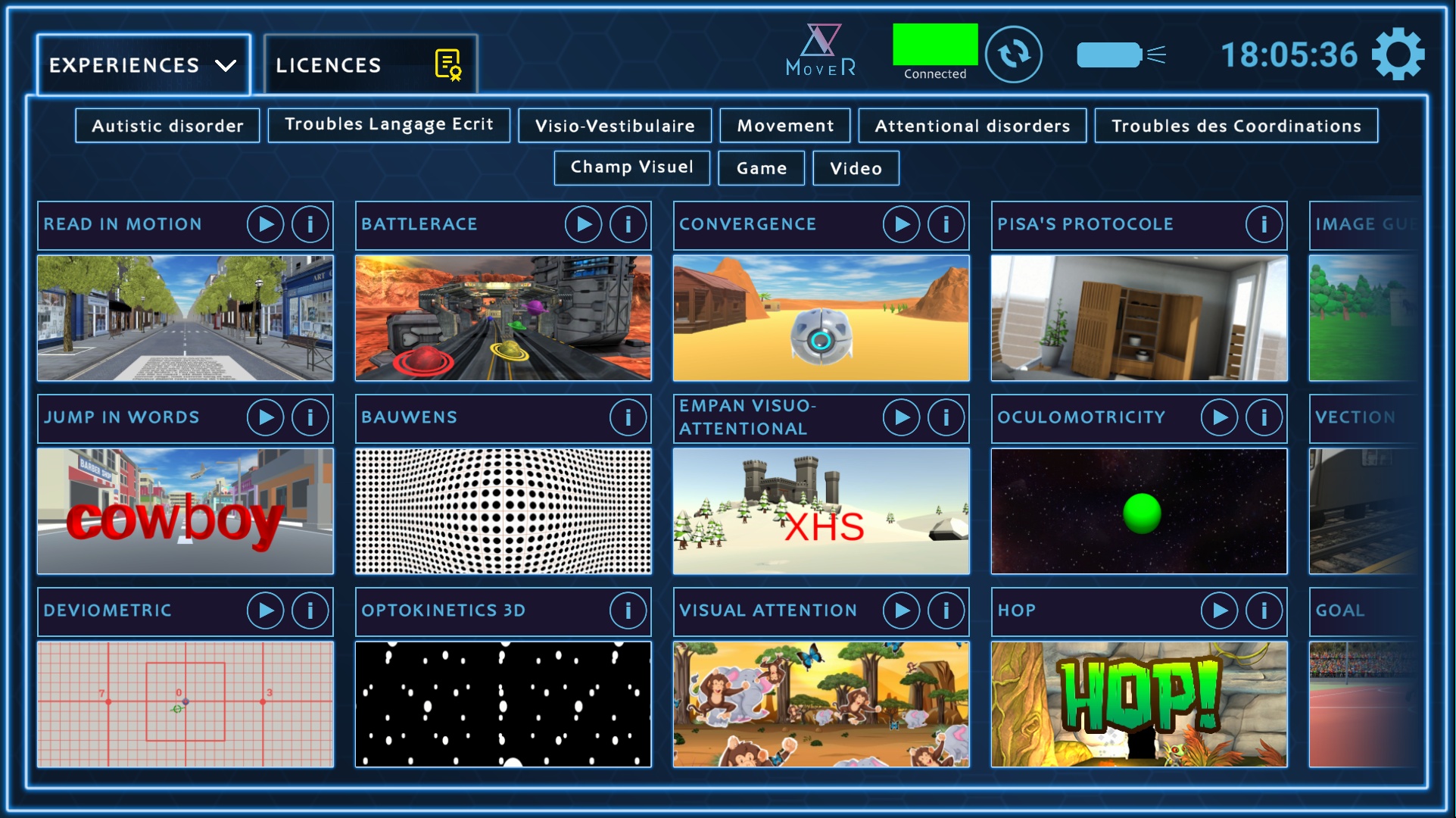
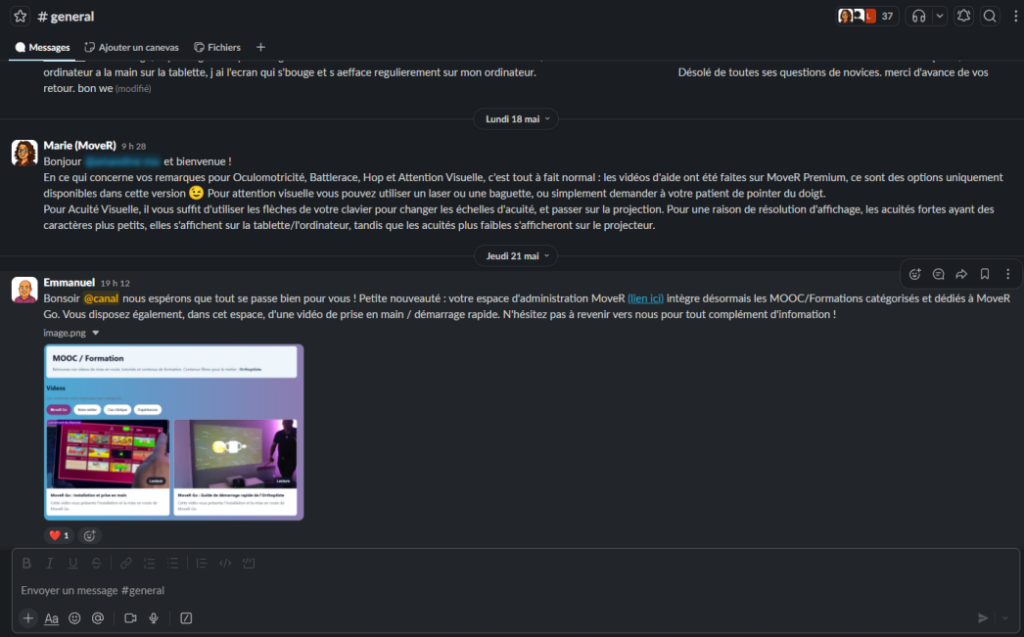
MoveR includes a library of experiences, as well as a dedicated platform for collaboration and communication between therapists and our development team. The library currently features 17 applications, with 3 new applications added every year, in addition to regular software updates.
More Than a Tool, a Complete Approach
With MoveR, you also take part in the platform’s continuous evolution. MoveR is built around a participatory approach: your needs and feedback as a therapist are heard, considered, and integrated into the software by our development team.
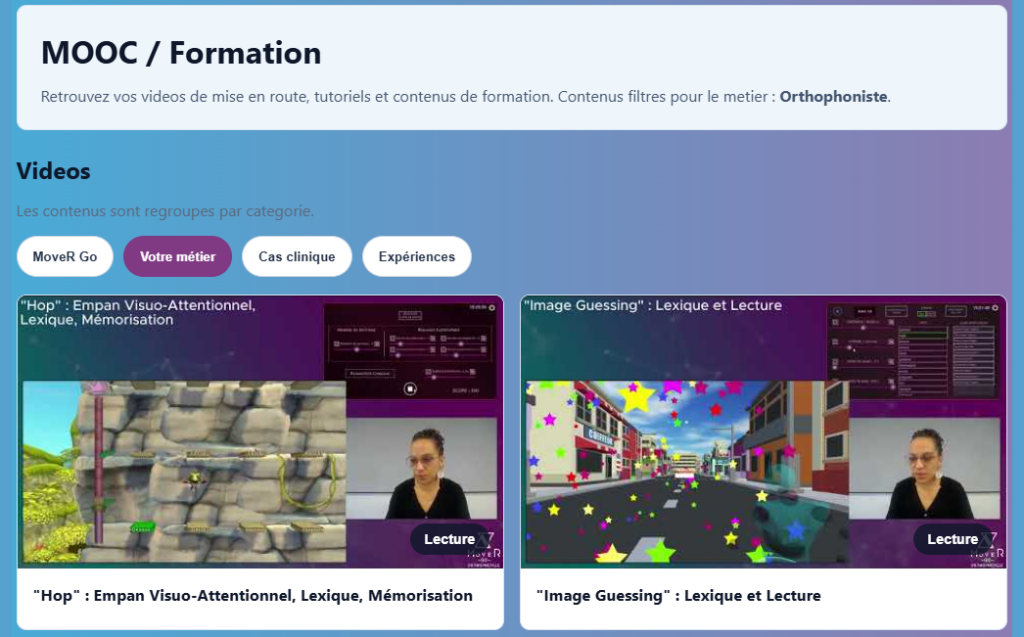
Training videos are also available to guide you through every step of onboarding, from technical setup to clinical and professional use (currently in French language but with English subtitles, English native version coming soon).
Join the Movement!
MoveR comes with a 30-day free trial. Each subscription includes access for up to 2 devices.
Click the button below to review the requirements and explore the different setup configurations available for your practice.What They’re Saying
Charlotte Gibert, an orthoptist in private practice at Clinique de l’Europe in Rouen, France, has been using MoveR extensively for over a year to treat learning and reading disorders.
“The experiences offered by MoveR are designed to address the visual challenges identified (based on the TVPS-4 manual) in individuals diagnosed with learning disorders such as dyslexia, attention deficit disorder (ADD), and developmental coordination disorder (DCD).
Through mixed reality, MoveR provides intensive stimulation of the neurovisual system, allowing patients to perform exercises at viewing distances approaching optical infinity.
MoveR also enables simultaneous stimulation of multiple sensory systems (visual, vestibular, and auditory), helping reinforce learning and skill acquisition through a multimodal approach.
MoveR is also designed to be fun and engaging for patients, maximizing their attention and motivation throughout each session.”
Thierry Guillot, a physical therapist specializing in vestibular rehabilitation at Pôle Vertiges et Équilibre, uses MoveR to help reduce visual dependence in patients with balance disorders.
“MoveR experiences are designed to address the following needs:
Reducing visual dependence in patients with balance disorders. MoveR experiences create sensory conflicts that encourage greater reliance on the somatosensory and vestibular systems.
Encouraging users to perform movements in response to tasks selected by the clinician, such as reaching for virtual objects or avoiding obstacles along a continuously moving course.”